
For many overseas visitors, St Lucia is one of those South African places that feels both easy to enjoy and wonderfully different from a standard beach holiday. It offers a rare mix of estuary views, wildlife, beaches, wetlands, restaurants and relaxed village life, all within reach of a comfortable self-catering base.
Spring Birding in St Lucia: 7 Special Birds to Look Out for in iSimangaliso
Spring in St Lucia is not something you only see. You hear it.
The forests become noisier, birds that have been quietly going about their business suddenly start calling from the trees, flowering and fruiting plants draw feeding parties into the open, and across the wetlands and grasslands there is a feeling that everything is becoming busy again.
For bird lovers, it is a lovely time to be here.
iSimangaliso Wetland Park is home to more than 520 recorded bird species, but you certainly don't have to try to find all of them in one visit. Part of the joy of birding in St Lucia is simply slowing down, listening, and seeing what turns up.
And if birding is the reason for your visit, Ingwenya Lodge makes a wonderfully easy base camp. You can head out early while the forest is waking up, come home for breakfast or a quiet afternoon, and venture out again when the day begins to cool.
Local bird guide Ian Ferreira of St Lucia Birding Tours keeps a close eye on what is happening around St Lucia throughout the year. His latest September observations are already showing that spring has arrived.
Here are seven special birds worth keeping your eyes — and ears — open for.
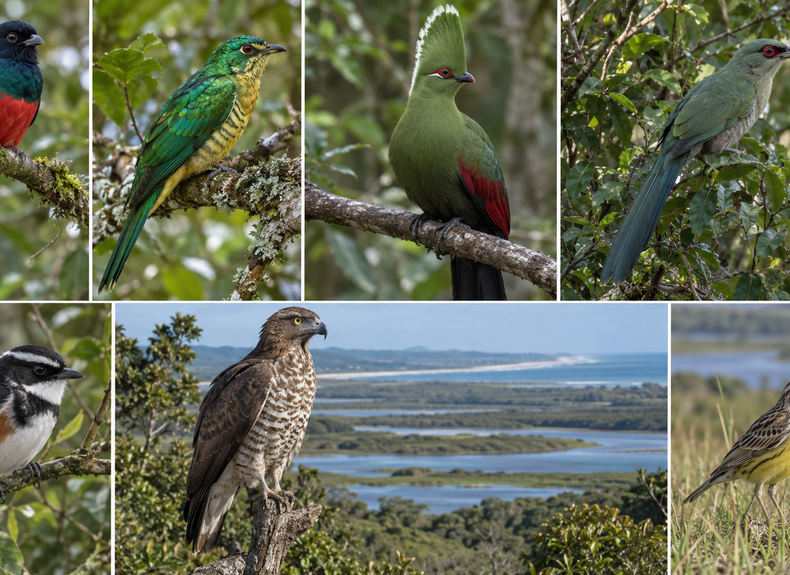
1. Narina Trogon

Photo: St Lucia Birding Tours – Ian Ferreira
If there is one bird that tells us spring is arriving in the St Lucia forests, it may just be the Narina Trogon.
They are here throughout the year, but that doesn't necessarily mean they are easy to find. Narina Trogons are remarkably good at disappearing into the darker parts of the dune forest. A bright green back suddenly becomes very useful camouflage when you are sitting quietly amongst green leaves.
Spring changes things.
During September and October the males become much more vocal, and this year Ian has already reported that they are calling properly again and that the first of their fascinating "floating leks" are beginning to form.
This is when groups of males can move through the forest together, calling and displaying as they compete for the attention of females.
You may hear them before you see them — which makes finally spotting that flash of deep green and brilliant red through the forest all the more rewarding.
2. African Emerald Cuckoo

Photo: St Lucia Birding Tours – Ian Ferreira
The male African Emerald Cuckoo really does live up to his name.
That beautiful emerald-green plumage, yellow breast and barred tail make him one of those birds that can stop even a casual nature lover in their tracks.
And at the moment they are making their presence known.
Ian reports that blossoming White Stinkwood trees around St Lucia are attracting large numbers of beetle larvae — and where there is an easy insect feast, the birds soon notice.
African Emerald Cuckoos are among the birds taking advantage of it this spring.
Their far-carrying call is often the first clue that one is nearby, so this is another case where birding with your ears can be every bit as important as birding with binoculars.
3. Livingstone's Turaco

Photo: St Lucia Birding Tours – Ian Ferreira
You may not always get a long look at a Livingstone's Turaco.
Sometimes all you see is a sudden flash of brilliant red wing disappearing through the trees. But once you know that flash, you won't easily forget it.
Livingstone's Turacos are resident in the dune forests around St Lucia, and their South African distribution is concentrated in the far north-eastern parts of KwaZulu-Natal.
They love fruiting trees, and this spring Wild Plum and Natal Fig trees have been drawing turacos and a whole collection of other fruit-loving birds into feeding areas.
Early mornings and late afternoons are particularly lovely times to listen for their distinctive calls.
They are one of those birds that remind you why the forests around St Lucia are as important to birders as the wetlands.
4. Green Malkoha

Photo: St Lucia Birding Tours – Ian Ferreira
The Green Malkoha is a good bird for teaching patience.
It likes thick vegetation, tangled branches and dense foliage — exactly the sort of place where a bird can know perfectly well that you are looking for it while giving you almost nothing to look at.
Sometimes you get the head. Sometimes the long tail. Sometimes just a movement in the leaves.
And then, if you are lucky, the whole bird appears.
Green Malkohas are sought-after birds around St Lucia and are often found moving with mixed-species feeding parties. They are particularly fond of caterpillars and other invertebrates, which is why the insect activity around flowering and blossoming trees can create some very interesting birding.
Ian has already been seeing them amongst the activity around the White Stinkwoods this spring.
They are not show-offs. That is part of their charm.
5. Woodward's Batis

Dune forest habitat. Photo: St Lucia Birding Tours – Ian Ferreira
This little bird tells a much bigger story.
Woodward's Batis is closely associated with the dune and coastal forests of this part of northern KwaZulu-Natal and is very localised within South Africa.
Around St Lucia it can be surprisingly easy to overlook.
Unlike some of the more energetic batis species, Woodward's Batis often sits quietly within dense vegetation. Even when you hear the male calling, finding exactly where that little call is coming from can take some patience.
Ian describes them as regular members of the forest bird community around St Lucia, and they have again been among the forest species observed during the past month.
For keen birders, this is an important species because it helps explain why iSimangaliso's protected dune forests matter so much.
Sometimes the most special birds are not the biggest or brightest ones. They are the birds that depend on a very particular place.
6. Southern-banded Snake Eagle

Photo: St Lucia Birding Tours – Ian Ferreira
Now we leave the darker forest and start looking up.
The Southern-banded Snake Eagle is one of the really special raptors of this region. Its close association with dune forest means that the protected habitat within iSimangaliso is particularly important for the species.
Early spring also brings an interesting change to the landscape.
Controlled burns take place in parts of the grasslands, leaving open patches where prey is suddenly much easier for birds of prey to see.
Ian's September update reports Southern-banded Snake Eagles among the raptors currently staking out these freshly burnt areas.
So while you may be concentrating on tiny birds moving through the forest one moment, don't forget to look up the next.
Birding in iSimangaliso has a habit of changing the plan for you.
7. Rosy-throated Longclaw
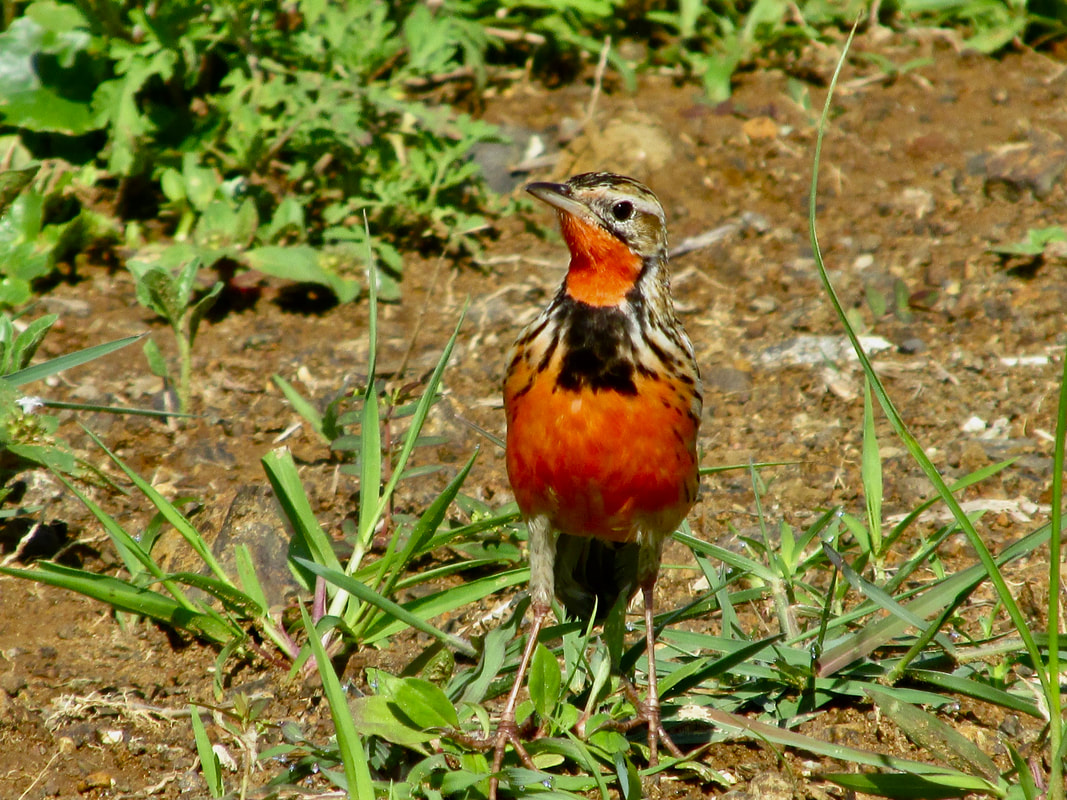
Photo: St Lucia Birding Tours – Ian Ferreira
And then there is the Rosy-throated Longclaw.
This is one for the birding wish list.
Rosy-throated Longclaws favour damp grasslands, floodplains and the edges of wetlands across the Zululand coastal plain, and iSimangaliso is one of the important areas where birders can search for them.
They can be unpredictable because their movements depend on rainfall and suitable habitat, so this is not a bird we would ever promise.
That is exactly what makes finding one so satisfying.
As spring develops and conditions across the grasslands and wetlands continue to change, it is a very good bird to keep in mind while exploring the Eastern Shores.
Why Birding in St Lucia Feels Different
Perhaps the most remarkable thing about birding here is not any one species.
It is how quickly the habitat changes.
You can start your morning beneath the canopy of dune forest listening for a Narina Trogon, drive out through open grassland looking for raptors, stop beside a wetland for waterbirds and longclaws, and end the day beside the St Lucia Estuary.
All without having to make the day feel like a race.
That diversity is one of the reasons iSimangaliso supports such extraordinary birdlife — forest birds, wetland birds, grassland specialists, raptors and seasonal visitors all finding their own place within the greater landscape.
If you'd like to explore with somebody who knows these birds and their habitats intimately, have a look at St Lucia Birding Tours with Ian Ferreira .
You can also read our earlier article about birding in St Lucia with Ian Ferreira , or discover more about why St Lucia is such a rewarding birdwatching destination .
Make Ingwenya Lodge Your Birding Base Camp
One of the nicest things about birding from Ingwenya Lodge is that your day can be as busy or as unhurried as you want it to be.
Leave early with binoculars and coffee, spend the morning exploring the forests, wetlands or Eastern Shores, and then come back to the lodge when the day warms up.
Have breakfast. Sit in the garden. Take a swim. Download your photographs. See what has wandered into the trees around the lodge while you were away.
Then, if you feel like it, head out again for the late afternoon.
That's why we like thinking of Ingwenya as a base camp rather than simply somewhere to sleep.
St Lucia and iSimangaliso are waiting outside. We simply give you a comfortable place to come home to between adventures.
Planning a Spring Birding Break in St Lucia?
Make Ingwenya Lodge your base camp and give yourself a little time to explore.
For availability, accommodation options or help planning your stay, contact Madeleine directly. She'll be happy to help.
Direct bookings with Madeleine
Phone: +27 72 172 2119
Email: [email protected]
Website: www.ingwenyalodge.co.za


Share This Post